How to play padel
Padel is a doubles racquet sport played on an enclosed court where the glass walls are in play. It keeps score like tennis, you serve from waist height or below, and you don't need any experience to start.
What is padel
Padel is a doubles racquet sport played on a walled court smaller than a tennis court. Two teams of two hit a ball that looks like a tennis ball over a net with solid, stringless racquets, and the glass walls around the court are in play: after the ball bounces, it can come off the glass and you can still hit it back. That's the part that surprises people, and it's what makes the game addictive. Scoring works the same way as tennis.
The court
A padel court is 20 meters long and 10 meters wide (about 66 × 33 feet), enclosed on all sides by walls (usually glass) and metal mesh. The back walls are 3 meters tall with mesh above them to 4 meters; the walls wrap the first 4 meters of each side, and the rest of the sides are mesh. A net 88 centimeters high in the middle and 92 at the ends divides the court in two.
It is about a quarter smaller than a doubles tennis court and about two and a half times the size of a pickleball court. There's a to-scale comparison of all three further down.
The walls aren't boundaries; they're part of the playing surface. After the ball bounces on your side, it can hit the glass and you can still play it. That one rule changes how every point develops.
The basic rules
Padel is played as doubles: two players per side.
The serve.
The server stands behind the service line, between the center line and the side wall, without touching either line. Bounce the ball behind the line and hit it at or below waist height, with at least one foot on the ground. Each game's first serve goes from the right side, then sides alternate. The serve must cross diagonally and land in the opposite service box, and you get two attempts. A serve that lands in and then hits the mesh is a fault; off the glass it's good. The serve passes to the other team after every game.
The bounce and the walls.
Your shot has to bounce on the floor on the other side before it touches their walls. After that bounce, the ball can come off the back or side glass and it's still in play. You can volley (take the ball out of the air) anywhere on your side, except when returning serve: the serve must bounce first.
Using your own wall.
You can also play the ball against your own glass to get it back over the net, as long as it then lands in the other team's court.
Losing the point.
You lose the point if the ball bounces twice on your side, if you hit it into the net, or if your shot hits the other team's glass or mesh before bouncing on their floor. Hitting the mesh on your own side also loses it.
Running outside.
On courts with open exits and a clear safety area outside them, play can leave the court. If the other team's shot bounces and then goes out over the side wall or through the exit at the net, you can run out and play it back before it bounces a second time. If it goes out over your back wall, you lose the point. Where the court has no safety area, a ball that leaves the court after bouncing wins the point for the hitter. It's one of the sport's most dramatic plays.
Scoring
Padel uses the same scoring as tennis. Points count 15, 30, 40, game. Win six games with at least a two-game lead to take the set; at six games all, a tiebreak decides it. Matches are best of three sets.
- 0Love
- 151 point
- 302 points
- 403 points
- Game4 points
At 40–40 (deuce), the rules allow three formats, so check which one your event uses:
Advantage
A team must win two points in a row from deuce, however long that takes.
Golden point
One deciding point at the first deuce wins the game. The receiving team chooses which side receives it.
Star point
Added by the International Padel Federation (FIP) in 2026. You play advantage twice; if the game reaches deuce a third time, one deciding point wins it.
Padel vs tennis
The two share a scoring system and a net, but they play very differently.
Drawn to the same scale
Tennis, doubles23.77 × 10.97 m (78 × 36 ft)2,808 sq ft (261 m²)
Padel20 × 10 m (about 66 × 33 ft)2,153 sq ft (200 m²)
Pickleball13.41 × 6.10 m (44 × 20 ft)880 sq ft (82 m²)
Court and walls.
A padel court is about a quarter smaller than a doubles tennis court and fully enclosed. The walls keep the ball in play, so rallies run longer.
Racquet.
A padel racquet has a solid face with small holes instead of strings, and it's much shorter than a tennis racquet: 45.5 centimeters long at most. That makes it easy to control at close range. It has a wrist cord, and the rules make you wear it.
Serve.
Tennis players serve overhead; in padel you bounce the ball and hit it at or below the waist. Aces are rare: the serve starts the point more than it wins it.
Doubles.
Padel is played in pairs: men's, women's and mixed. Tennis also has singles.
What wins.
Tennis rewards power and reach. Padel rewards placement, angles and reading the walls, which is a big reason beginners can compete sooner.
Padel vs pickleball
Padel and pickleball have more in common with each other than either has with tennis.
Walls.
The biggest difference: padel has them and pickleball doesn't. You can defend a shot that got past you by reading it off the glass behind you.
Court size.
A padel court (20 × 10 m) is about two and a half times the area of a pickleball court (13.41 × 6.10 m, or 44 × 20 ft).
Scoring.
Padel uses tennis scoring: 15, 30, 40, game, set, match. Pickleball games usually go to 11, win by 2.
Ball.
Padel uses a rubber ball that looks like a tennis ball. Pickleball uses a perforated plastic ball.
Serve.
Both serve low: padel at or below the waist, pickleball underhand.
Who plays.
Both are doubles-first, quick to learn and social. Pickleball has far more courts in the US today; padel is most visible in cities where clubs have built dedicated courts.
What you need
A racquet.
Most padel clubs rent racquets, so you don't need your own to start.
Balls.
Clubs sell them. Use padel balls, not tennis balls: they look alike, but padel balls are made to the padel federation's own size, weight and bounce limits.
Shoes.
Non-marking court shoes: tennis shoes, indoor court shoes or padel shoes. Running shoes aren't built for side-to-side movement.
Clothes.
Standard athletic wear.
How to start at your school
You don't need experience, tryouts or your own equipment.
Find a court.
ACPL's courts page lists the host clubs where ACPL teams play, by division.
Join a club, or start one.
More than 50 college clubs are part of ACPL. If your school isn't one of them, registering a school is free.
Play the season.
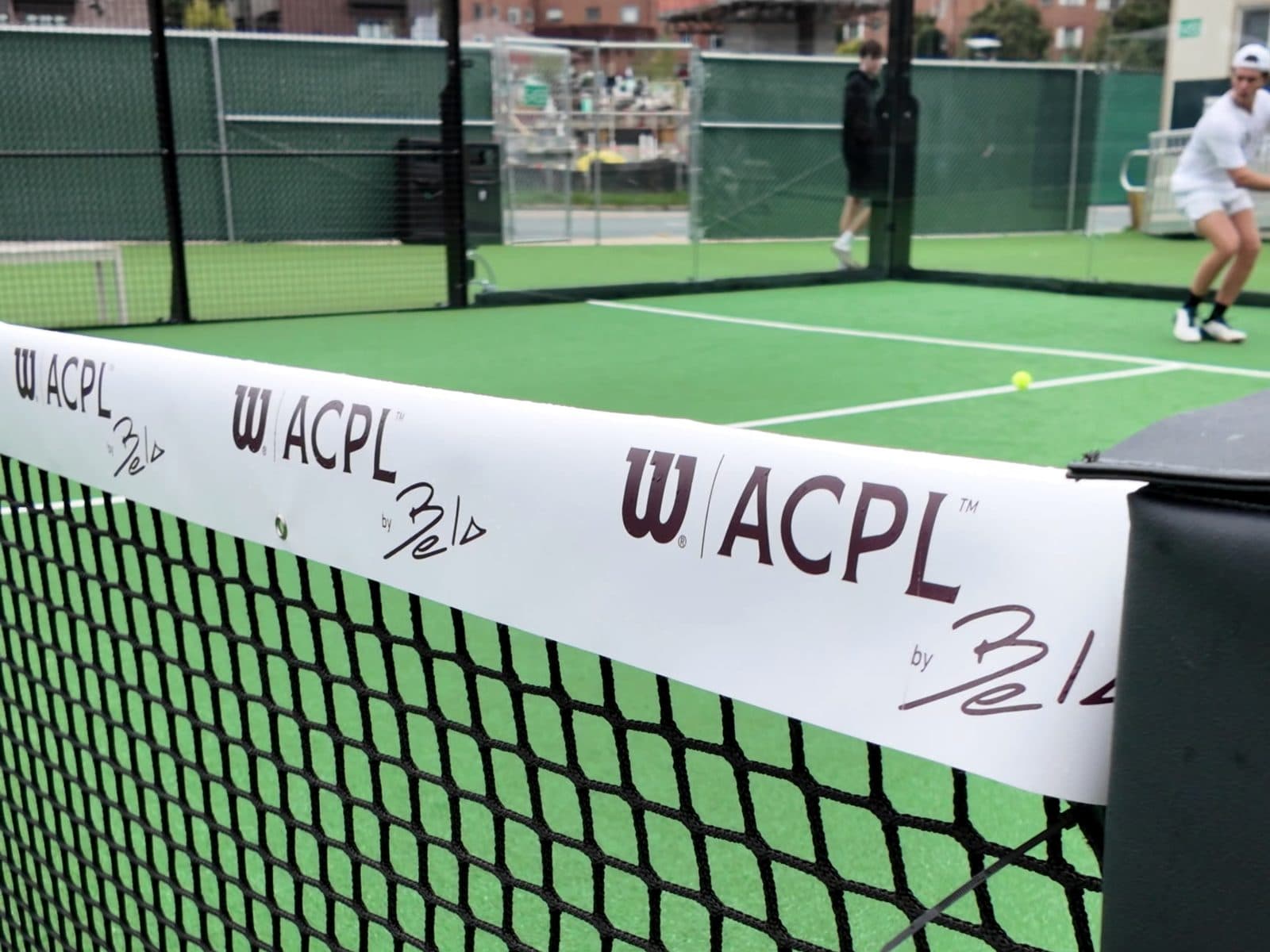
The ACPL season runs across four regions (Atlantic, Sunshine, Lone Star and Pacific) through City Invitationals and Regional Championships to the National Finals in Miami in March 2027. Player membership is $25 a year. Season 1, Wilson ACPL by Bela, has more than 300 student-athletes.
Questions
- Do I need to be good at tennis to play padel?
- No. The low serve, the shorter racquet and the enclosed court make padel easier to pick up than tennis, and beginners can have real rallies in their first session.
- How long does a match take?
- A best-of-three-sets match usually takes 60 to 90 minutes.
- Can I play singles?
- Padel is built for doubles, and doubles is the standard game and the one played in competition.
- Is padel the same as paddle tennis?
- No. Paddle tennis and platform tennis are different sports with their own courts and rules. Padel's defining feature is the glass walls, which are part of play.
- Is padel an NCAA sport?
- Not currently. College padel is played as a club sport, and ACPL runs a national league season for college padel clubs.
- How much does it cost to play?
- Court time is booked by the hour and split four ways; the price depends on the city and the club. Most clubs rent racquets. ACPL player membership is $25 a year, and registering a school is free.